

“Earthly time-keeping is not for me”, says Udo Lindenberg, a twenty-something in the body of a seventy-something. “With other people my age I always think: that’s a completely different generation. I’m timeless. They also call me the Elasto-Man. I’m as lithe as a gazelle, my fitness is excellent.” Lindenberg does a lot of sport: at night he jogs in all weathers around Hamburg’s Alster or through Berlin’s Tiergarten, “always about seven kilometres”. The fittest green sock under the sun, then, is still going full throttle.
What Does That Even Mean?
Sure, Lindenberg is carrying a proud 76 years – but what does that even mean? In fact you get the impression that the man grows ever more restless the further he drifts, on paper, from his youth. Only this summer, after two paralysing Covid years, he was back on tour with his Panikorchester. They were special concerts: people were craving live music, and the avowed pacifist and champion of tolerance, respect and diversity put his peace messages more centre-stage than ever. “Wozu sind Kriege da?” (1981) and “Wir stehen im Frieden” from the MTV Unplugged album (2018) he performed with the children’s choir Kids on Stage – moving moments.
Faced with today’s crises, does Lindenberg still believe in the utopias of the 1960s? “Yes! We need such ideals. No borders, no walls, but human chains – that’s my dream. I stand up for a fairer world, against war and ever more weapons. We have to save the oceans, curb climate change, fund our social systems – those are utopias, sure. But I also know that a lot can succeed. Woodstock helped bring the Vietnam War to an end, as did the civil-rights movement with Martin Luther King. It’s great when people stand up for something.” He admires the youngsters of Fridays for Future: “It’s fantastic when young people push back against greed and the exploitation of people and resources.”
A One-Off Who Lifts Spirits
Lindenberg is not only an absolute one-off but perhaps also Germany’s foremost spreader of hope. For years he has campaigned vigorously against right-wing extremism and for the cohesion of society. Above all, his studio albums “Stark wie Zwei” (2008) and “Stärker als die Zeit” (2016), with the optimism anthem “Durch die schwersten Zeiten”, have given many people something to hold on to. And you believe him when he sings: after all, the man has lived through every conceivable high and low himself.
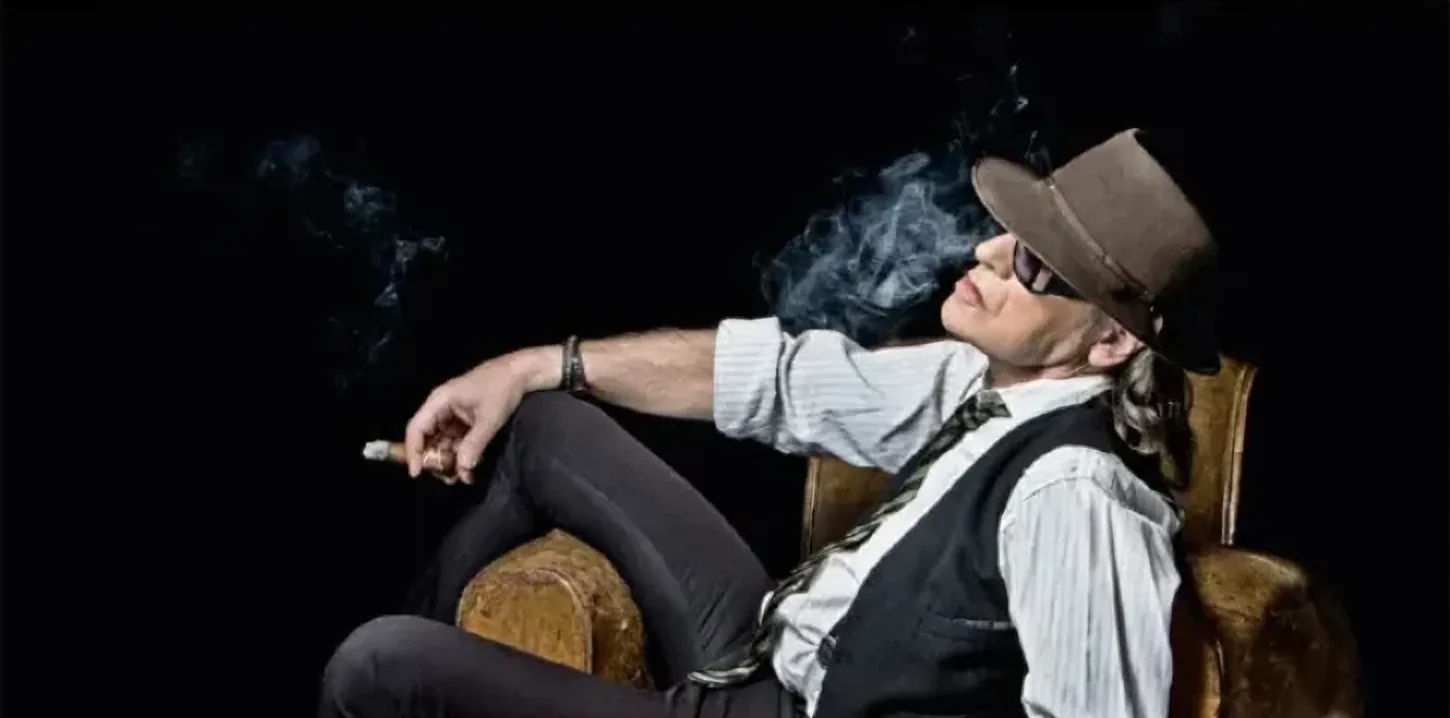
“Giving up just isn’t my thing. My life has had violent swings up and down, but quitting was never an option for me. The show has to go on.” – Udo Lindenberg, musician
From Waiter to Star
Lindenberg was born into a war-traumatised, drab West Germany. He grew up with his parents in Gronau, Westphalia; his father Gustav was a plumber who dreamed of becoming a conductor. The son discovered the drums, moved to Düsseldorf while still a minor, began an apprenticeship as a waiter and at 17 spent a year in Libya playing for US soldiers. “I was my own boss early on. That’s the finest thing there is.” He drummed in Klaus Doldinger’s band Passport, then went solo in the early 1970s – with his cheeky, brash German songs he filled the gap between rock and Schlager. “Just daring to sing in German when everyone else sang in English – that was bold. But I knew it had to work somehow.” The commercial breakthrough came in 1973 with the hits “Alles klar auf der Andrea Doria” and “Cello”; the biopic “Lindenberg! Mach dein Ding” (2020) and the autobiography “Udo” tell that story too.
In 1981, with his hit “Sonderzug nach Pankow”, Lindenberg probably did more to bring East and West closer than most politicians managed in decades. Stamps bearing his likeness followed, a musical, legendary status – but also repeated alcohol-fuelled crashes. Yet when the artist, who has lived for decades at Hamburg’s Hotel Atlantic, pulled off his big comeback in 2008 with “Stark wie Zwei”, he settled into a more measured lifestyle. “The boozing days are long gone”, Udo insists.
Radicality and Mastery
The Panik rocker is nowhere near done. “Some ask: don’t you want to retire? But I’d rather keep reinventing myself and stay the eternally young talent.” In old age, Lindenberg says, two things count: radicality and mastery. He has both in abundance. Since the late 1990s he has been with the photographer Tine Acke; he has no children. “I promised people I’d keep going for another 50 years. And medicine has come so far – with life pills I’ll easily make 126. I can’t let people down: they need their Udopium.”
This article appeared in MEN issue 2/22 (November 2022).


